If you press play on your first Turkish drama and notice the timer says two hours, you have not made a mistake. Most dizi episodes run far longer than the 22 or 45 minutes that dominate Western television, and some stretch beyond two and a half hours. For first-time viewers it can feel like a commitment before the story has even started.
There are real reasons behind it, and understanding them makes the format much easier to enjoy. This guide explains where the long runtime comes from, how it affects the way stories are told, and the practical ways fans cope with it.
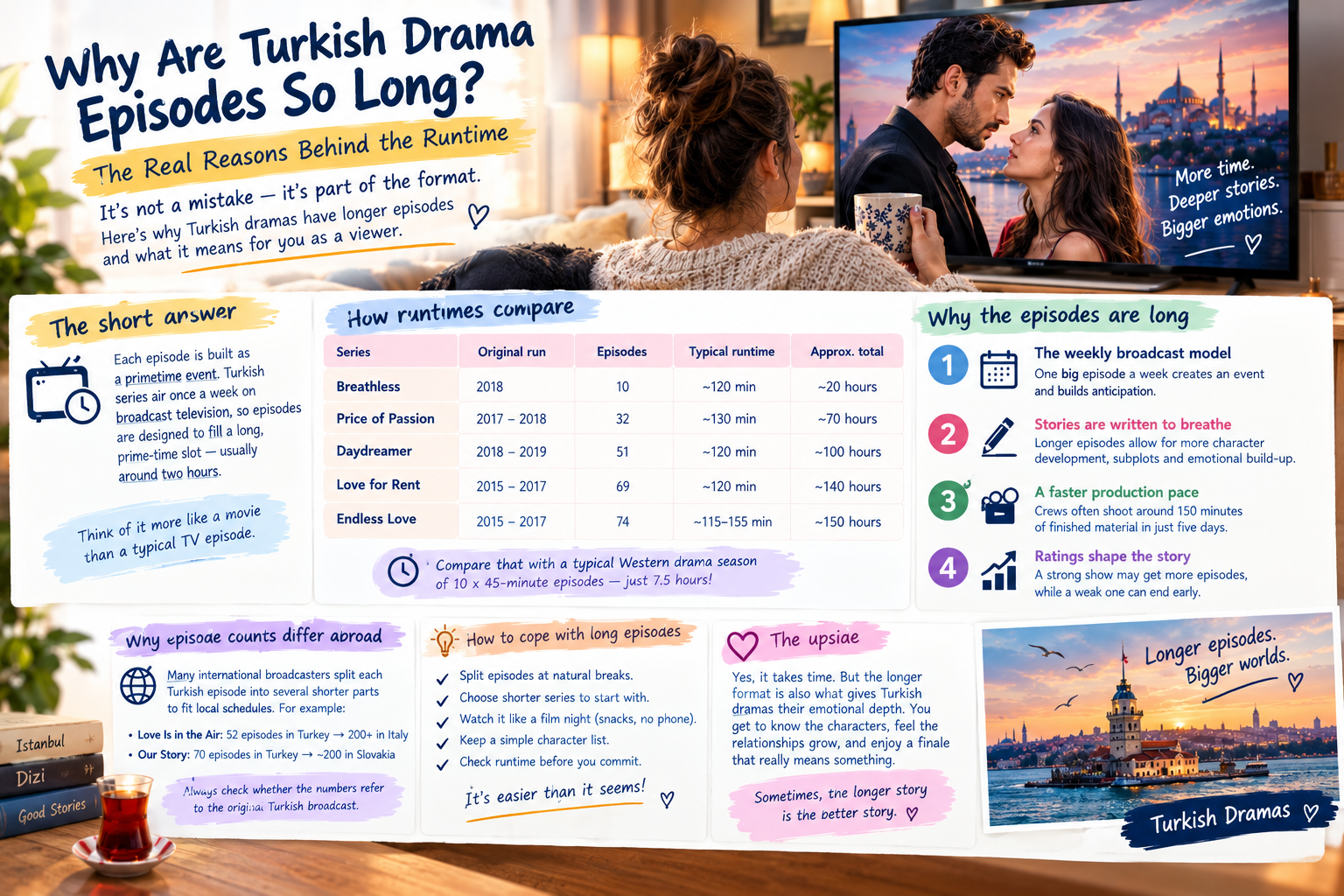
The short answer: each episode is built as a primetime event
Turkish series are designed for broadcast television, where one new episode airs each week in a prominent evening slot. Instead of spreading a story across several short episodes a week, Turkish channels give each series a single, very large block of time. The result is an episode that is conceived more like a feature film than a half-hour installment.
This is the foundation for everything else. Once a weekly slot is long, writers, directors and editors plan scenes, subplots and cliffhangers to fill it.
How runtimes compare in practice
Here is how some popular titles look in terms of episode length and total viewing time:
| Series | Original run | Episodes | Typical runtime | Approx. total |
| Breathless | 2018 | 10 | ~120 min | ~20 hours |
| Price of Passion | 2017 to 2018 | 32 | ~130 min | ~70 hours |
| Daydreamer | 2018 to 2019 | 51 | ~120 min | ~100 hours |
| Love for Rent | 2015 to 2017 | 69 | ~120 min | ~140 hours |
| Endless Love | 2015 to 2017 | 74 | ~115 to 155 min | ~150 hours |
Compare that with a typical Western drama season of ten 45-minute episodes, which comes to about seven and a half hours. A single Turkish episode can be longer than three of those.
Reason 1: The weekly broadcast model
Because a Turkish series airs once a week, viewers are asked to give up one evening for it. Channels treat that evening as an event, and the long runtime is part of the promise. Fans often plan their week around a favorite show, and audiences on social media discuss every episode as it airs.
Reason 2: Stories are written to breathe
A long episode changes how scenes are written. Conversations run longer, silences are held, and characters are given time to react. Ensemble casts get proper subplots, which is why even a love story like Endless Love spends so much time on families, rivals and friends. The pacing can feel slow at first, but it is what allows an emotional payoff to feel earned.
Reason 3: An extraordinary production pace
Making that much material every week is demanding. In an interview with Drama Quarterly, Endless Love director Hilal Saral explained that her team shoots around 150 minutes of finished footage in just five days, a pace that surprised international colleagues. Turkish productions typically film continuously while the series is on air, adjusting the story as the season progresses. That rhythm is a major reason the genre has a distinct feel, and it is also why long seasons demand such stamina from cast and crew.
Reason 4: Ratings shape the story as it airs
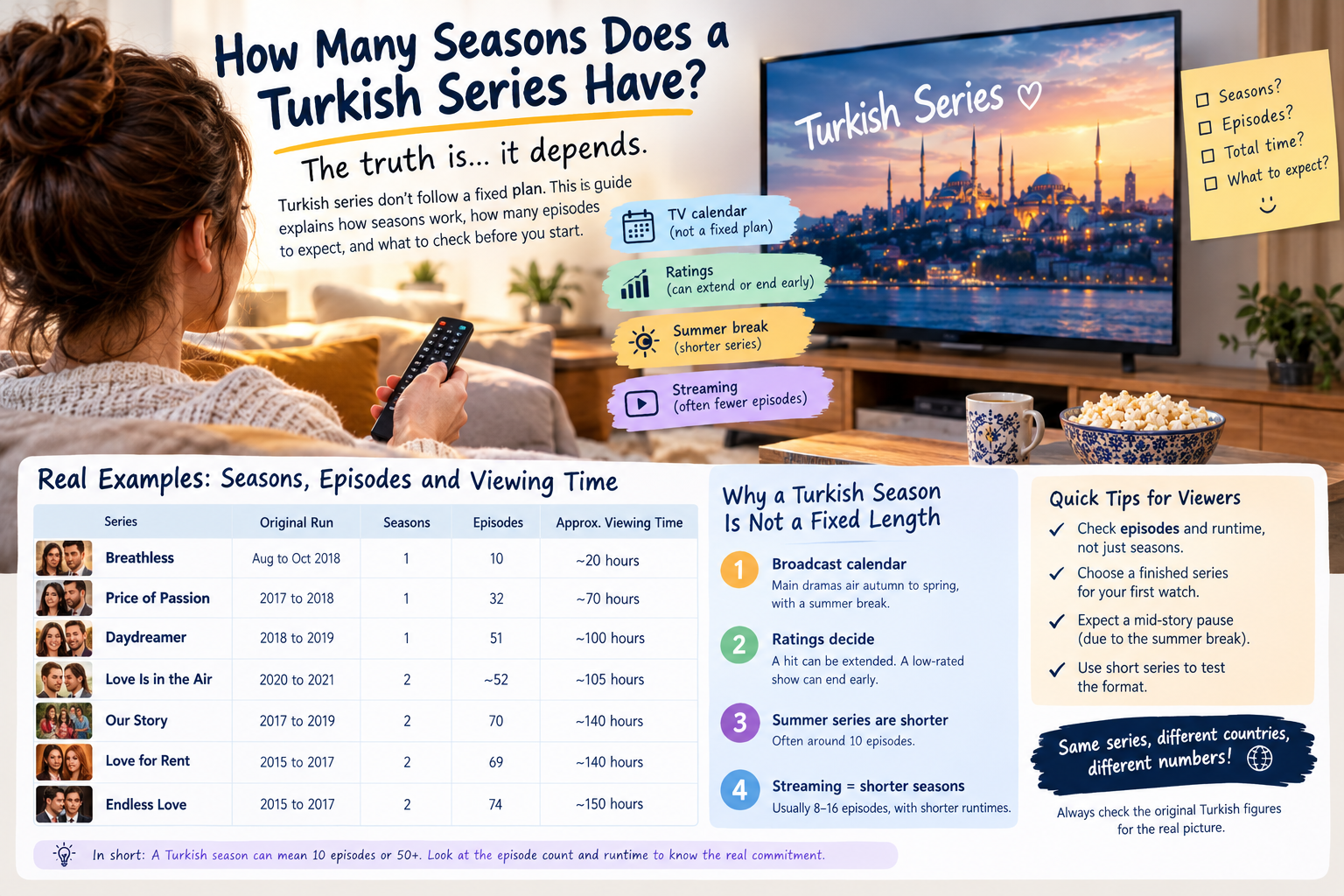
Because episodes are produced while the show is broadcasting, ratings can influence what happens next. A strong series may be given more episodes, and a weak one may be wrapped up early. We cover this in more detail in our guide to how many seasons Turkish series have.
Why the same series can have different episode counts abroad
If you have ever seen a Turkish drama listed with a very different number of episodes than you expected, that is usually a re-cut. Many international broadcasters split each two-hour Turkish episode into several shorter parts to fit local schedules. Love Is in the Air has just over 50 episodes in Turkey, but Italian broadcasters aired it as more than 200 episodes. Our Story (Bizim Hikaye) ran for 70 episodes in Turkey and was shown as roughly 200 in Slovakia. When you compare episode counts between sources, check whether the number refers to the original Turkish episodes or a local re-cut.
Is the trend changing?
Yes, gradually. Series made for streaming platforms tend to use shorter episodes and tighter seasons, and some broadcast productions have trimmed their runtimes in recent years. The classic two-hour format remains common, particularly in the series that built the genre's international reputation, so newcomers should still expect long episodes when they explore older favorites.
How to cope with two-hour episodes
- Split episodes at natural breaks. There is no rule that says you must watch in one sitting. Pause where the scene changes and continue the next day.
- Choose shorter series first. A compact title like Breathless lets you experience the format for about 20 hours before deciding whether to try something longer.
- Plan viewing like a film night. Treat one episode as a movie rather than a casual episode, with snacks and no phone.
- Keep a simple character list. Long runtimes mean big casts, and a quick note about who is related to whom helps you stay oriented.
- Check runtime before you commit. Each show page lists runtime and episode counts, so you can decide whether a series suits your schedule. You can browse by top rated or newest to find candidates.
The upside of the long format
It is easy to focus on the time cost, but the length is also what gives Turkish dramas their emotional depth. Relationships develop gradually, side characters become people you care about, and a finale lands with real weight because you have lived with the story for weeks. Many viewers find that after a few episodes, the pacing that felt slow becomes the main reason they keep watching.
If you are just beginning, our step-by-step guide on how to start watching Turkish dramas and our list of the best Turkish dramas for beginners will help you pick a first series that suits your schedule.
Frequently asked questions
How long is a typical Turkish drama episode?
Most run about two hours, although some are shorter and a few run well beyond two and a half hours. Newer streaming productions are often closer to an hour.
Why are Turkish drama episodes longer than Korean drama episodes?
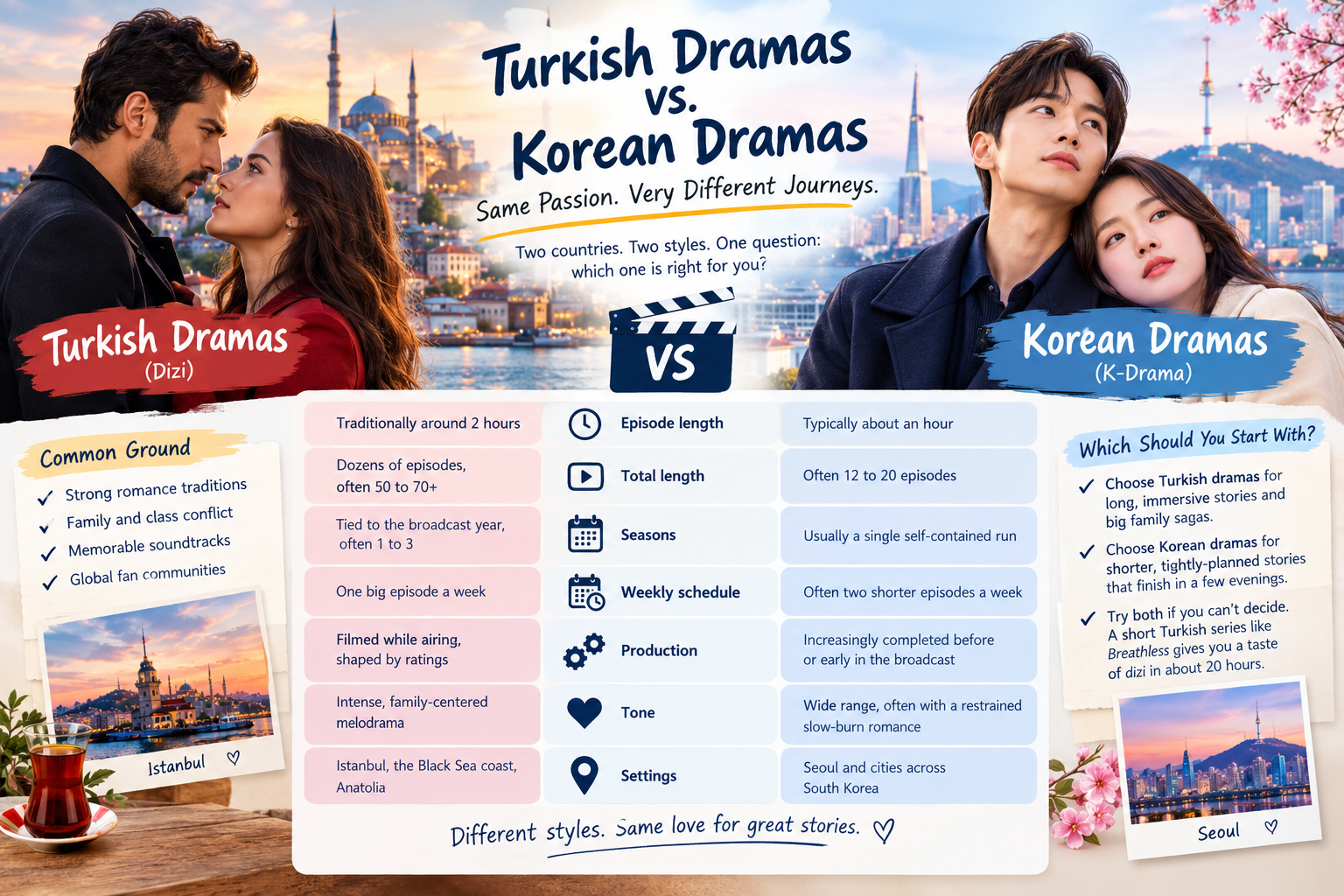
Turkish series are built around one big weekly primetime slot, while Korean series usually air in shorter episodes two nights a week. We compare the two in our guide to Turkish drama vs Korean drama differences.
Can I skip scenes to save time?
You can, but the slower scenes often carry the emotional setup for later events. If time is short, choose a shorter series instead of skipping through a longer one.
Why does the same show have more episodes in other countries?
International broadcasters often cut each long Turkish episode into several shorter parts, which increases the episode count without adding any story.
Are all Turkish series this long?
No. Runtime varies by production and platform, and shorter limited series are becoming more common. Always check the runtime listed on the series page.